FlowEdit: Information-Theoretic Control of LLM Reasoning Flows for Ill-posed Problems Involving Conflicts

TL;DR
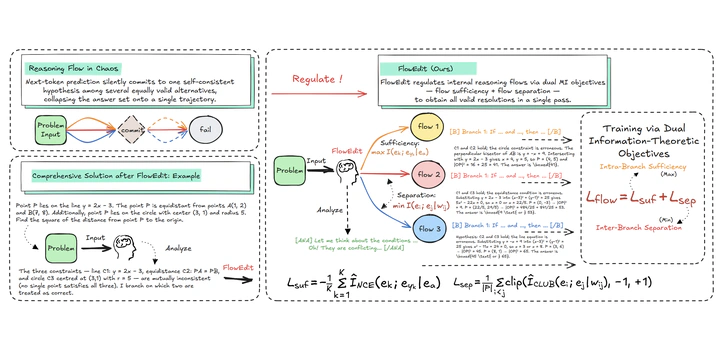
FlowEdit gives LLMs a principled way to handle ill-posed problems — questions with conflicting or mutually incompatible conditions. Instead of silently collapsing onto one self-consistent hypothesis, it regulates the model’s internal reasoning flows so that competing hypotheses survive in parallel branches, returning the full set of valid answers in a single pass.
Key contributions:
- An information-theoretic control framework for internal reasoning flows, with dual mutual-information objectives: flow sufficiency (maximize information from each hypothesis to its outcome) and flow separation (minimize overlap across branches).
- The mechanism operates by redistributing next-token entropy within the model’s token stream, making hidden conflicts explicit.
- Outperforms leading proprietary models: +68% exact-set-match accuracy and +24% overall response informativeness.
BibTeX
@misc{tang2026flowedit,
  title={FlowEdit: Information-Theoretic Control of LLM Reasoning Flows for Ill-posed Problems Involving Conflicts},
  author={Sizhe Tang and Guangyu Jiang and Yu Li and Rongqian Chen and Ioannis G. Kevrekidis and Tian Lan},
  year={2026},
  eprint={2607.20500},
  archivePrefix={arXiv},
  url={https://arxiv.org/abs/2607.20500},
}