From Description to Interactive VR Scene: An LLM Agent for Authoring Immersive Experiences

TL;DR
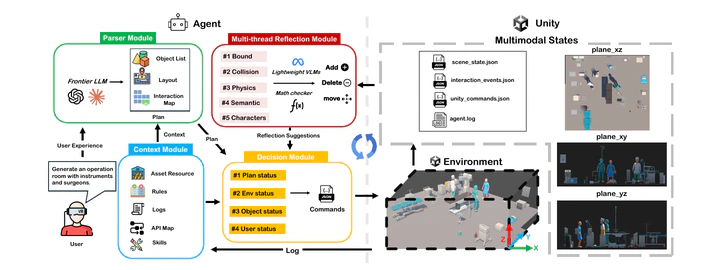
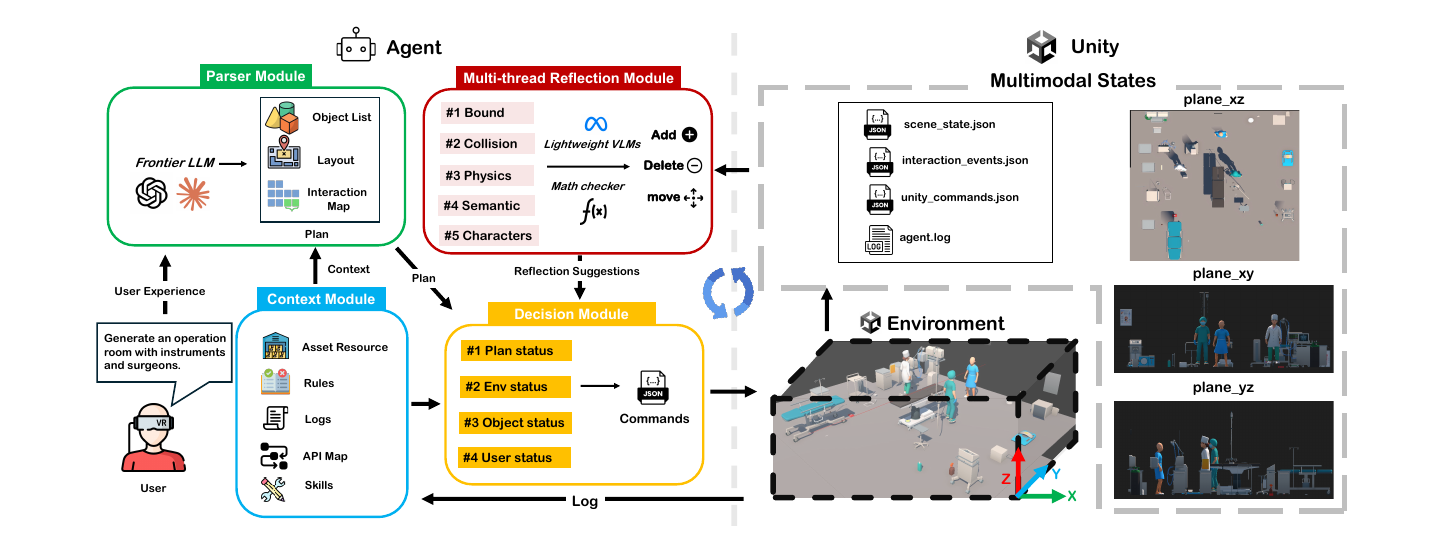
Describe a healthcare training experience in plain English (for example, “generate an operation room with instruments and surgeons”), and the agent builds the entire interactive VR scene in Unity: objects, layout, characters, per-object interactions, and a sequential story line.
Key contributions:
- A multi-module agent architecture (Parser, Context, Multi-Thread Reflection, Decision, Unity Operation) that lowers the authoring barrier for immersive medical visualization from code and 3D tooling to natural language.
- A two-tier LLM design: a frontier LLM handles a few high-leverage calls (scene synthesis, interaction map, story line), while lightweight VLM critics paired with deterministic checkers (Bound, Collision, Physics, Semantic, Characters) close the reflection loop over three orthogonal screenshots.
- An LLM-free interaction layer: an interaction map of per-object affordances and a strictly sequential story line are compiled to JSON up front, so runtime responses need no further LLM calls.
- Evaluated on 15 specialty-diverse healthcare-VR scenarios (45 trials): the correct object set is recovered in every scene at 5.1 frontier-LLM calls and 113 s per trial, with story lines averaging 5.0 beats.
BibTeX
@inproceedings{chen2026description,
  title={From Description to Interactive VR Scene: An LLM Agent for Authoring Immersive Experiences},
  author={Chen, Rongqian and Andreyev, Allison and Wang, Xuan and Jiang, Jianan and Li, Bin and Lan, Tian},
  booktitle={IEEE VIS 2026 Workshop on Visualization and Generative AI (VIS x GenAI)},
  year={2026}
}