Reasoning Knowledge-Gap in Drone Planning via LLM-based Active Elicitation
Feb 12, 2026·,,, ,,,
,,,
Zeyu Fang
Beomyeol Yu
Cheng Liu
Zeyuan Yang
Rongqian Chen
Yuxin Lin
Mahdi Imani
Tian Lan
TL;DR
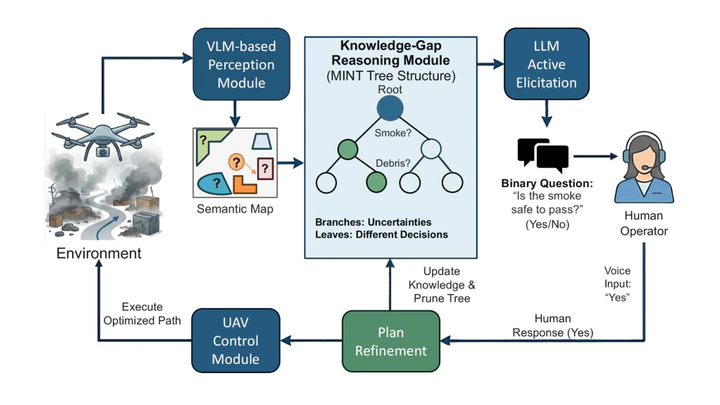
Instead of handing over control when a drone runs into uncertainty, this work makes the drone ask the right (minimal) questions: the MINT tree structures its knowledge gaps, and an LLM turns them into optimal binary queries for the human operator.
Key contributions:
- MINT (Minimal Information Neuro-Symbolic Tree): a reasoning mechanism that explicitly structures knowledge gaps about obstacles and goals into a queryable format.
- LLM-formulated optimal binary queries that resolve specific ambiguities with minimal human interaction.
- A complete workflow — VLM perception, voice interface, low-level UAV control — validated in NVIDIA Isaac simulation and real-world deployments, significantly improving search-and-rescue success rates while reducing human interaction frequency.
BibTeX
@misc{fang2026reasoning,
      title={Reasoning Knowledge-Gap in Drone Planning via LLM-based Active Elicitation},
      author={Zeyu Fang and Beomyeol Yu and Cheng Liu and Zeyuan Yang and Rongqian Chen and Yuxin Lin and Mahdi Imani and Tian Lan},
      year={2026},
      eprint={2603.07824},
      archivePrefix={arXiv},
      url={https://arxiv.org/abs/2603.07824},
}